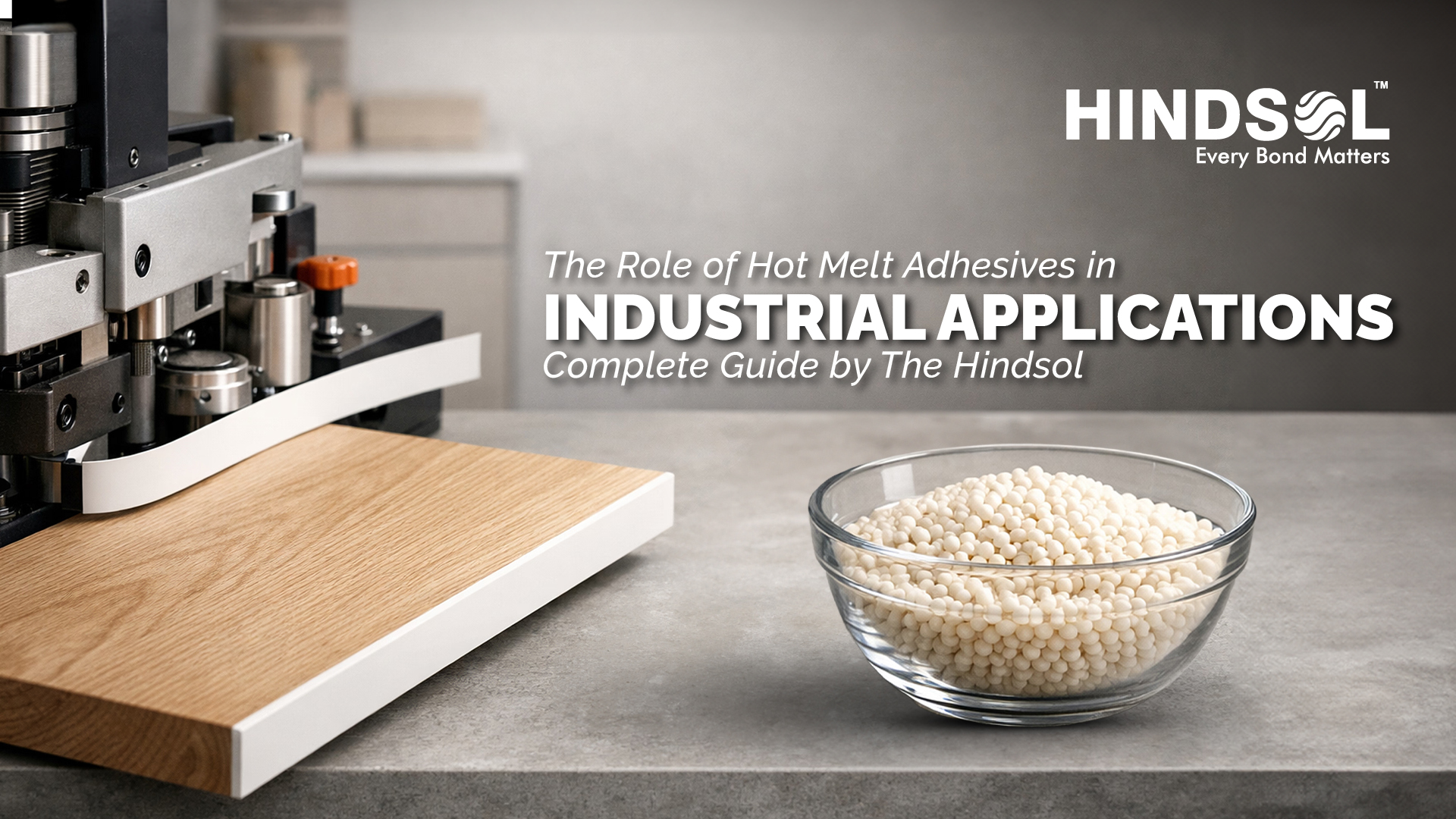
The Role of Hot Melt Adhesives in Industrial Applications – Complete Guide by HindSol
In modern manufacturing, speed and precision define competitiveness. Industries can no longer afford long curing cycles, material inconsistencies, or bonding failures that interrupt production. This is where hot melt adhesives have reshaped industrial assembly.
The growing Role of Hot Melt Adhesives in Industrial Applications is directly linked to their ability to deliver fast setting, clean application, and reliable bonding across multiple substrates. From packaging and product assembly to insulation and bookbinding, these thermoplastic adhesives have become essential in high-volume operations.
This guide explains the uses of hot melt adhesives in industry, their types, and why choosing the right formulation matters.
What Are Hot Melt Adhesives?
Hot melt adhesives are thermoplastic bonding materials applied in molten form. When heated, they liquefy; when cooled, they solidify and create strong bonds without requiring chemical curing.
Unlike solvent-based systems, industrial hot melt adhesive solutions offer:
- Rapid bonding
- Minimal downtime
- Reduced waste
- Cleaner application processes
These properties make them ideal for automated manufacturing environments.
Types of Hot Melt Adhesives for Industrial Use
Selecting the correct formulation is critical for performance and durability. The main types of hot melt adhesives for industrial use include:
1. EVA (Ethylene Vinyl Acetate) Based Adhesives
Commonly used in packaging, labeling, and carton sealing. EVA adhesives provide cost-effective bonding and moderate heat resistance.
2. Polyolefin-Based Adhesives
Designed for higher temperature resistance and improved chemical stability. Suitable for demanding industrial conditions.
3. Polyamide-Based Adhesives
Used where superior heat resistance and mechanical strength are required.
4. Reactive Polyurethane (PUR) Hot Melt
These adhesives combine fast initial set with chemical crosslinking after cooling, delivering long-term durability and structural strength.
Each category supports specific hot melt adhesive applications depending on load requirements, environmental exposure, and substrate compatibility.
Uses of Hot Melt Adhesives in Industry
The uses of hot melt adhesives in industry extend across sectors due to their versatility.
- Packaging Industry
Carton sealing, tray forming, labeling, and end-of-line packaging rely heavily on hot melt glue for industry because of quick setting and clean bonding.
- Woodworking & Furniture
Edge banding, panel lamination, and component assembly benefit from strong adhesion and aesthetic finish.
- Textile & Foam Bonding
Hot melt adhesives provide flexible bonding for insulation materials and foam lamination processes.
- Bookbinding
Applied for spine bonding due to fast processing and consistent performance.
- Electronics & Assembly
Used for wire tacking, component stabilization, and protective sealing.
Across these sectors, hot melt adhesive applications support automation and production scalability.
Why Hot Melt Adhesives Are Ideal for Industrial Manufacturing
The increasing Role of Hot Melt Adhesives in Industrial Applications is driven by practical advantages:
- Fast Production Cycles: Adhesives set within seconds, allowing continuous production.
- Clean Operation: No solvents or water evaporation means minimal mess and improved workplace safety.
- Material Compatibility: Effective bonding across paper, cardboard, wood, plastic, fabric, and foam.
- Reduced Inventory Loss: Long shelf life and minimal waste compared to liquid adhesives.
- Energy Efficiency: Modern application systems are optimized for controlled heating and precise dispensing.
These benefits explain why industries prefer industrial hot melt adhesive systems for both lightweight and structural bonding tasks.
Choosing the Right Industrial Hot Melt Adhesive
The selection of hot melt glue for industry should consider:
- Substrate type
- Operating temperature range
- Required bond strength
- Open time and setting speed
- Production line speed
- Environmental exposure
An unsuitable formulation can result in poor adhesion, thermal failure, or production slowdowns.
Growing Demand for Hot Melt Adhesives in India
With expanding manufacturing, logistics, and packaging sectors, India’s industrial growth has increased demand for a reliable hot melt adhesive manufacturer India that can provide:
- Consistent formulation quality
- Bulk supply reliability
- Technical support
- Application-specific customization
Industrial buyers require dependable partners who understand production realities and performance expectations.
How HindSol Supports Industrial Applications
HindSol develops performance-focused hot melt adhesives engineered for demanding industrial environments. As a trusted hot melt adhesive manufacturer India, the company focuses on:
- Controlled raw material selection
- Application-specific formulations
- Uniform viscosity and bonding strength
- Compatibility with automated dispensing systems
- Reliable supply for high-volume operations
By aligning product chemistry with industrial process requirements, HindSol ensures that manufacturers achieve efficient bonding without compromising quality.
Conclusion
The expanding Role of Hot Melt Adhesives in Industrial Applications reflects a broader shift toward faster, cleaner, and more reliable manufacturing solutions. From packaging lines to furniture assembly, the uses of hot melt adhesives in industry continue to grow as automation advances.
Selecting the right industrial hot melt adhesive and working with an experienced hot melt adhesive manufacturer India ensures long-term operational efficiency and product integrity.
To explore tailored hot melt adhesive applications for your industry, connect with HindSol’s technical team and discover bonding solutions built for performance-driven manufacturing.
